Practice
YogaTerapia — Yoga for Stress & Burnout
There are moments when we have to stop and listen to what the body is telling us.
Important Notice: YogaTerapia is a complement, not a treatment. It does not replace medical, psychiatric, or any other healthcare professional's care. Practice should only begin with clinical approval (a medical clearance form is required). We ask that you inform your therapist and healthcare professionals of any change in your condition.
What YogaTerapia Is
Yoga, by definition, holds that its practices support the healing and integration of body, mind and consciousness. YogaTerapia takes this principle and structures it into a clinical, systematic approach: the therapeutic application of yoga tools — postures, breathing techniques, meditation — to specific health conditions.
The practice is based on adapting to each practitioner individually, following an intake / personal assessment.
The core philosophy rests on a systematic approach that considers the nature of each health condition and selects the Āsana, Prāṇāyāma and meditations most useful for that condition, always adapted to the individual. It explicitly rejects the strict medical model of "cure" as mere symptom reduction or elimination.
What We Work With
Every programme is different, because every person is different. Even so, there are common tools:
Adapted Āsana (Postures)
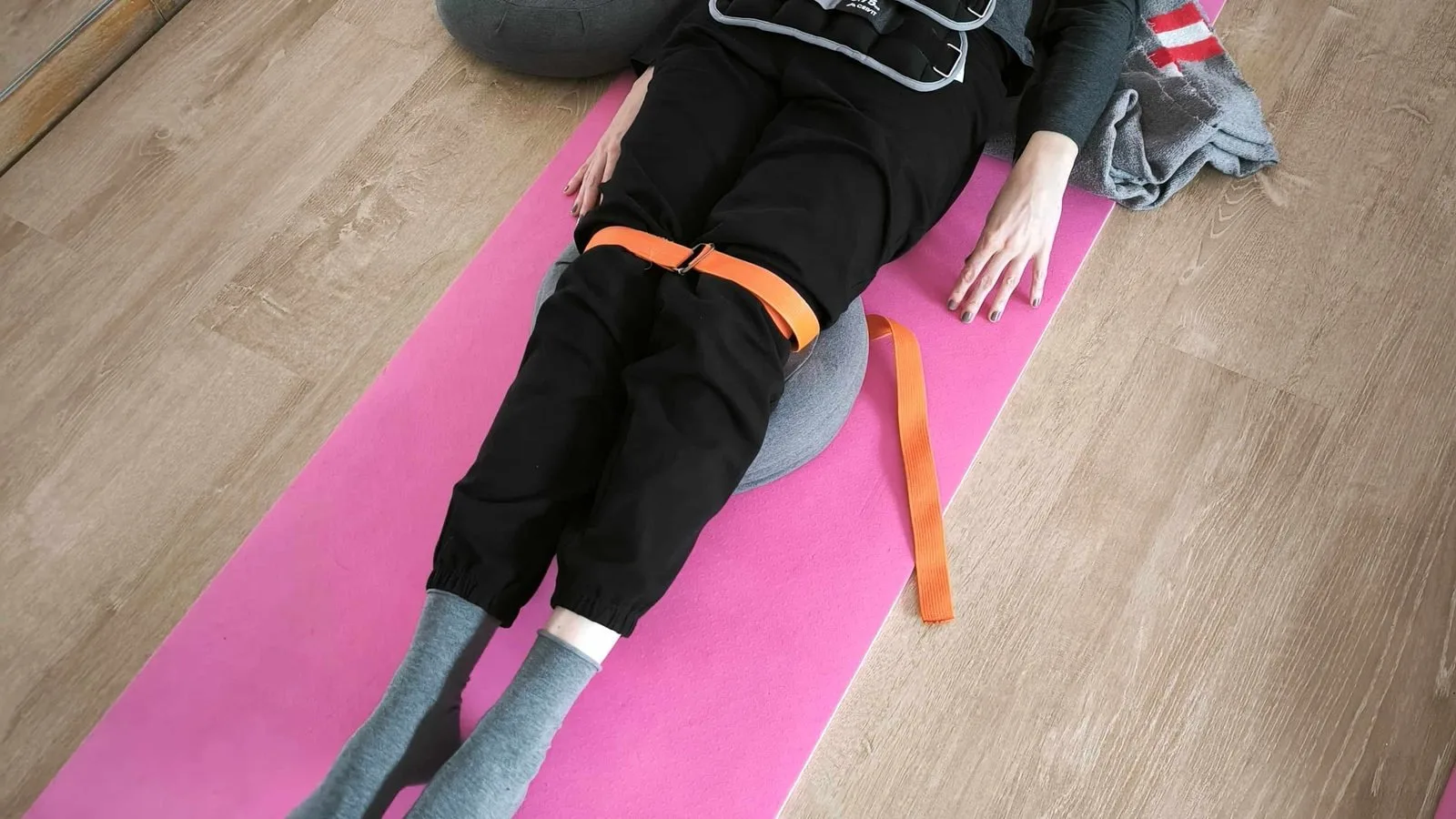
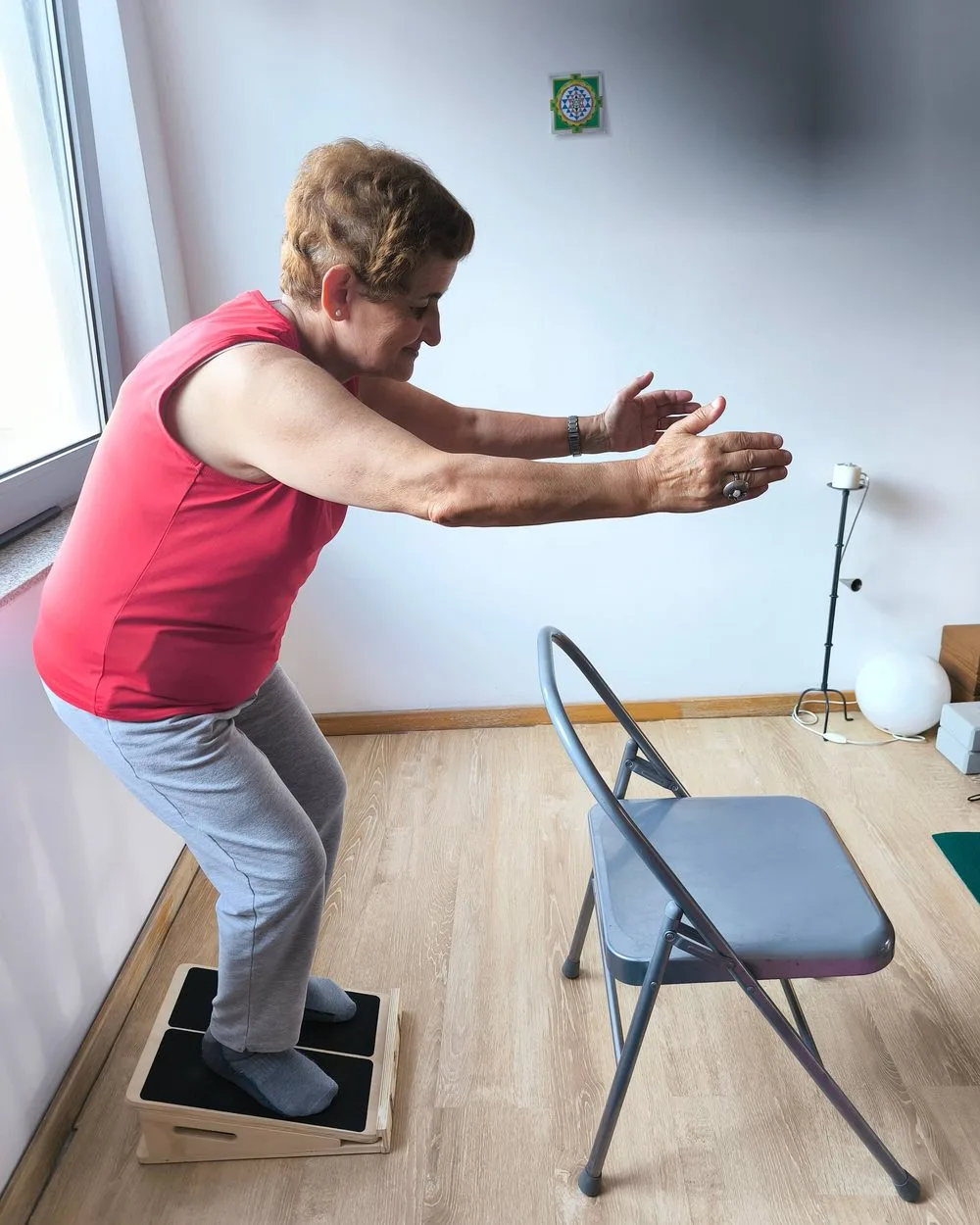
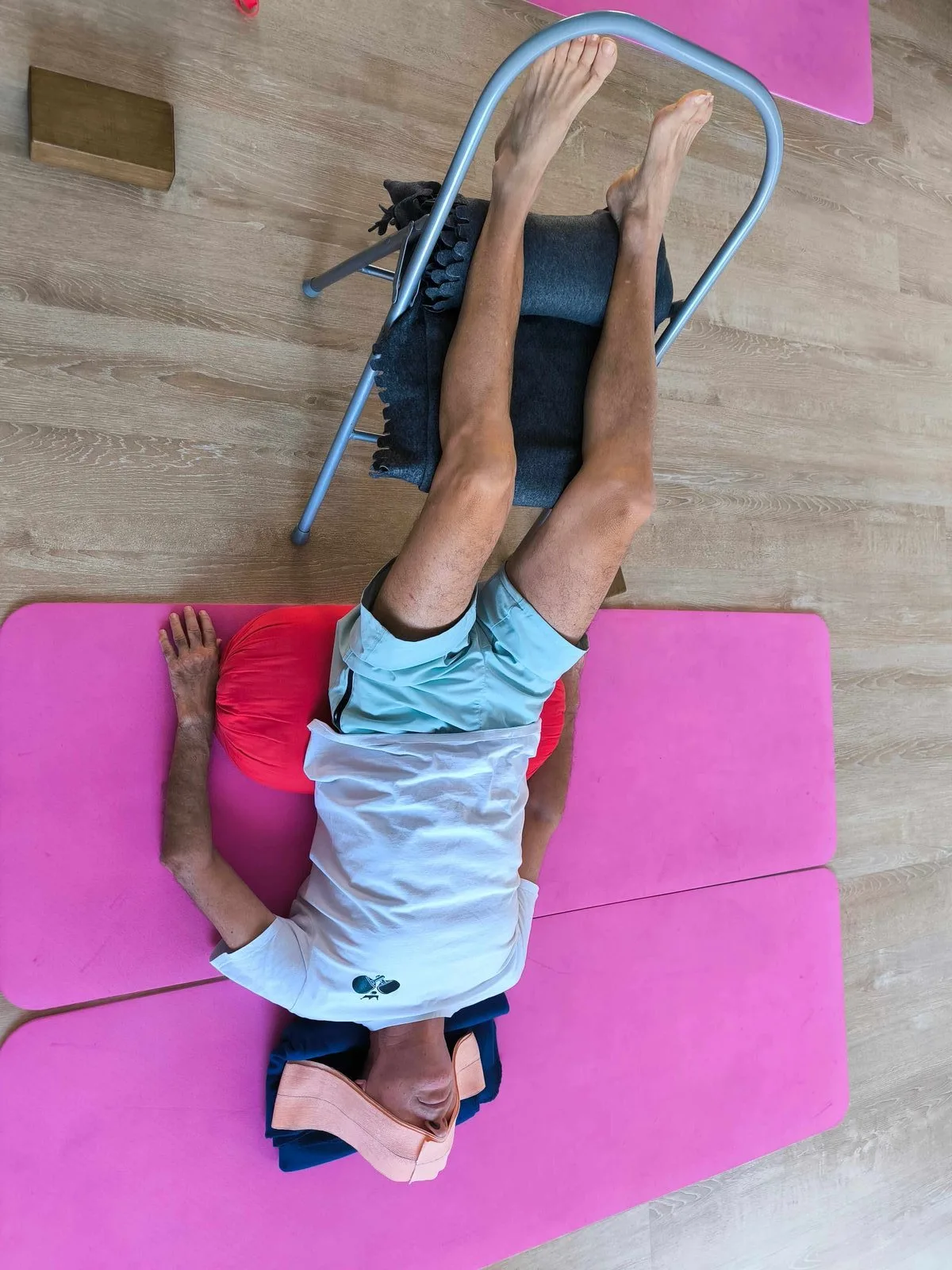
There are no mandatory positions. Wherever discomfort exists, we use adaptations — chairs, cushions, the wall as support, straps and weights — so the practice stays comfortable.
Examples: chair-based postures for those who cannot stay on the floor, supported stretches, wall-assisted positions for greater stability and balance.
Prāṇāyāma (Breathing Techniques)
Breath is the bridge between the physical body, the nervous system and the mind. That's why we use breathing as a mechanism to regulate the nervous system — something we also go deeper into on the Meditation / Rāja Yoga page.
Stress, burnout and anxiety show up in the breath — which usually becomes fast, shallow, disconnected. Working with different breathing approaches gives the practitioner tools to find balance and build autonomy over their own wellbeing.
Examples: slow, complete abdominal breathing (activates the parasympathetic system); Anuloma / Viloma (alternate-nostril breathing, which brings breath awareness and balances both brain hemispheres and energy).
Yoganidrā (Deep Guided Relaxation)
For people dealing with depression, anxiety and burnout, restorative sleep is often hard to come by. In these cases we use Yoganidrā — "yogic sleep." It can be practised lying down or propped up with support, and aims to bring the practitioner into a state of deep, restorative, replenishing physical relaxation.
Vichara — Time to Listen
This is what sets it apart. A yoga class has a defined rhythm and sequence. A YogaTerapia session has a rhythm that varies week to week, and is entirely individual.
Sessions open with a conversation: "How's your breathing?" "Has the pain changed?" "Has your sleep improved?" The practice is then adapted from there.
What YogaTerapia Is Not
Medical Treatment
YogaTerapia does not replace a doctor, psychiatrist or physiotherapist. It is a complement — serious, structured, and delivered by trained YogaTerapists. It supports conventional treatment; it never substitutes for it.
It Does Not Promise a Cure
YogaTerapia doesn't promise "cures." What it promises is to help the practitioner face their condition with more ease, bringing understanding along the way.
It Requires Clinical Oversight
To join a YogaTerapia programme, there's a protocol: a medical clearance form is recommended. Whenever needed, we ask you to stay in touch with your healthcare provider — physiotherapist, psychologist, oncologist, and so on — to keep everyone aligned.
A Process of Listening
YogaTerapia requires active listening:
- To the body: where there's tension, where there's openness
- To the breath: fast or slow, blocked or flowing
- To the person's story: how they got here, what they've already tried, what results they've had
- To the changes week by week: what's shifted, what needs adjusting, what's working
Who YogaTerapia Is For — A Preventive Approach
Chronic pain and physical limitation — fibromyalgia, musculoskeletal pain, mobility limitations. Approach: adapted Āsana, conscious breathing, Yoganidrā (chronic pain often stems from an overactivated nervous system and inflammation).
Stress, burnout and mental health — professional burnout, anxiety, insomnia, depression (always to be seen as a complement to psychiatric care). Approach: Yama and Niyama, Prāṇāyāma, Yoganidrā and Emotional Regulation.
Oncology support — support during and after treatment, for recovery, managing side effects, and rebuilding trust in the body.
Post-surgical recovery — gentle rehabilitation after operations, always complementary to physiotherapy and with clinical clearance.
Ageing and frailty — seniors with reduced mobility, compromised balance, diminished muscle strength.
How a Session Works
First session — conversation and assessment (60-90 min): begins with a structured conversation about medical history, goals, what's already been tried, and current limitations. This is followed by an assessment — we observe posture, breathing, mobility, without judgement, purely observation. From there, a personalised programme is designed.
Following sessions — adapted practice (60-90 min): a brief check-in about the week, followed by adapted Āsana (15-25 min), Prāṇāyāma (10-15 min) and Yoganidrā (20-30 min). The sequence varies according to how the person is doing that week.
Recommended frequency: one session a week is ideal, depending on the condition and the goal.
Training & Experience
Trained in YogaTerapia with Gonçalo Correia (Yoga Kshetra, Yoga Pros (Yoga Alliance Professionals UK)).
Trained in Yoga for Stress and Burnout with Gonçalo Correia.
Kaivalyadhama Yoga Institute.
Regular classes at the Liga dos Amigos do Hospital de Gaia, in a protocol with the Psychiatry department, and support for patients in oncological recovery.
Frequently Asked Questions
Do I need a medical clearance form?
Yes. For a YogaTerapia programme it's required. Ask your doctor — it's a simple form confirming you're able to practise yoga with adaptations.
How many sessions before I start feeling a change?
It depends on the condition. Some people feel relaxation from the very first session. Real change (reduced stress, better sleep, less pain) usually appears after 4-6 weeks of consistent practice.
Can I do YogaTerapia if I have a specific medical condition?
Most likely, yes — but it needs clinical approval. YogaTerapia has adaptations for practically every situation. Get in touch and tell us about your situation.
Is YogaTerapia confidential?
Yes. The same confidentiality protocol as any therapy applies. We don't share details of your health with third parties.
What if my condition changes during the programme?
Then we adapt. The programme is dynamic — it responds to your body at every stage.
Can I do YogaTerapia while I'm in treatment at the same time?
Yes. In fact, it's common to be in psychotherapy, on medication, in physiotherapy, and doing YogaTerapia all at once — as long as it's well coordinated with your healthcare providers.