Yoga: origin of the word, correct pronunciation and philosophical evolution
The word Yoga derives from the root √yuj, which carries multiple definitions depending on context and point of view.
What this article sets out to show is that, like a tree with many branches, each School holds a valid point of view — and these branches enrich one another.
Yoga reaches far beyond the contemporary view, which focuses mainly on Āsana: the physical, energetic and body-awareness postures.
Oṃ Namaḥ Śivāya · Rui Pascoal Mahā Dev
What does "Yoga" mean?
The word Yoga comes from the Saṃskṛta yogaḥ, tied to the verbal root √yuj, which expresses ideas such as to unite, to bind, to yoke, to connect and to harmonise. This root is essential for understanding why the term has always been associated with integration, discipline and inner transformation. In its broadest sense, Yoga is defined as the philosophical path put into practice — the practical counterpart to what Sāṃkhya describes in theory.
Today we tend to fence concepts and definitions in. But if we remember that Yoga comes from a tradition vast in both time and geography — from Nepal to the Middle East — we see that it's impossible to settle on a single definition of Yoga.
In some views Yoga is the union of individual and cosmic consciousness; in others, Yoga is the cessation of the mind's fluctuations; in others still, Yoga is the practical philosophical method for attaining mokṣa, Liberation — from mortality into the Eternal.
These multiple points of view aren't separate from one another, but different branches of the same tree, complementing each other even where they diverge.
The Sanskrit root
The yoke — iugum in Latin, joug in French — descends from the same Indo-European root.
In Saṃskṛta, the family of words linked to Yoga points to the semantic field of "joining," "binding" and "placing under the same yoke." This is why Yoga relates to the Latin iugum and the English yoke, which carry the same idea of a bond: all descend from the same Indo-European root.
The resemblance helps convey the word's antiquity, but its meaning in India is far broader than this mechanical image.
Within Haṭha Yoga, the term represents the union of the opposing forces Iḍā and Piṅgalā, used to awaken the Kuṇḍalinī at the base of the spine and guide it through the central channel — Suṣumṇā nāḍī — up to the higher cakras.
Pāṇini (4th century BCE), the linguist and grammarian who structured classical Saṃskṛta, is the author of the Dhātupāṭha, the catalogue of verbal roots tied to his grammar. There he defines yuj in more than one sense:
yujir yoge — "yuj in the sense of uniting"
yuja samādhau — "yuj in the sense of concentrating"
That is: of samādhi, the state of total absorption of consciousness.
Yoga or Ioga? The correct pronunciation
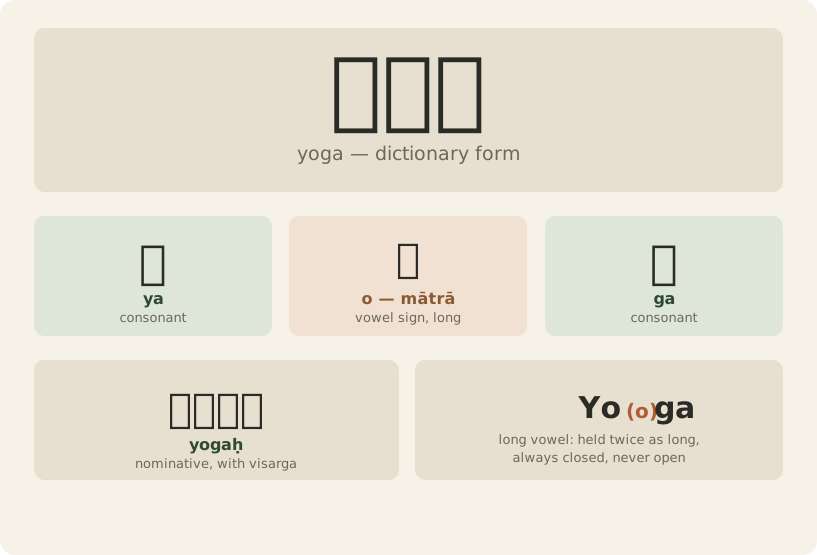
Anyone who looks closely at the academic transliteration of Saṃskṛta notices a curious detail: the vowels a, i and u appear either plain or with a bar above — ā, ī, ū — but o always appears unmarked.
The macron marks vowel length, because in Sanskrit a/ā, i/ī and u/ū are distinct pairs: short and long. The o exists only in its long form — Indian grammarians called it sandhyakṣara, a diphthong vowel.
The correct way to voice the o in Yoga is closed and lengthened, close to the vowel in the English words "go" or "hope" — never the short, open sound some speakers default to. In Portuguese specifically, the correct sound is the closed ô of "avô," not the open ó of "avó": a distinction that doesn't exist in Saṃskṛta at all, since the open variant simply has no equivalent in the original language.
Portuguese has more than one written form for the word:
- Yoga — the form used in international academic literature and closest to the transliteration. It's the one this article, and English usage generally, follows.
- Ioga — the Portuguese phonetic spelling registered in dictionaries, though it drifts from the transliteration.
- "Yôga" — a spelling meant to steer pronunciation toward the closed o. In my own view this is a mistaken choice, since it's used mainly to create a distinctive "brand" and a certain affiliation with particular schools.
One important note: IAST is the international convention for transliterating Saṃskṛta. Its purpose is to let anyone, even without knowledge of the language, read it with correct phonetics.
Why keep the original form
Vedic Saṃskṛta was transmitted orally for centuries through recitation disciplines of extreme rigour: the pāṭha, memorisation methods that repeated each text in multiple cross-orders, precisely to prevent a single sound from becoming corrupted across generations.
Phonetics is absolutely central to the transmission of knowledge — in the gurukulam, the teacher–student relationship, and in the paramparā, transmission from mouth to ear.
Multiple definitions across time
Each tradition has shaped the term to its own purpose. Throughout history, Yoga has been understood:
- as union between the individual and the absolute;
- as discipline of the senses and the mind;
- as an inner state of stability or absorption;
- as a method of liberation;
- as a philosophical school within Indian thought.
This diversity shows that the word isn't fixed. Its meaning depends on the tradition, the text, and the spiritual or philosophical purpose behind it.
Yoga and diversity: the many traditions
Yoga is in dialogue with several currents within India, and remains a living, evolving process.
In Tantra, the body, energy and ritual can occupy a central place, and Yoga is often woven into practices for transforming consciousness.
In Jainism, the term takes on its most surprising sense: it means almost the opposite of what it means in other traditions. Here, yoga appears as the activity of body and mind that binds and generates karma. What the Jain practitioner seeks is precisely to become free of it — to extinguish Yoga itself.
In Vaiṣṇavism, Yoga is reinterpreted through devotion, surrender and relationship with a personal divine.
In Śaivism, especially within certain tantric and non-dual traditions, the focus shifts toward the recognition of absolute consciousness.
In other words: the same word gathers different points of view, which enrich the practice and turn it into a living history — one that keeps building and reinventing itself.
Yoga as disunion from suffering
In Patañjali's Yoga Sūtra, Yoga receives a classical and very precise definition:
yogaś citta-vṛtti-nirodhaḥ (YS I.2)
"Yoga is the cessation of the fluctuations of the mind."
tadā draṣṭuḥ svarūpe 'vasthānam (YS I.3)
"Then the seer rests in its own true nature."
This formulation shows that Yoga is not only union, but also dis-identification from the causes of suffering. The Bhagavadgītā declares, in its sixth chapter:
taṃ vidyād duḥkha-saṃyoga-viyogaṃ yoga-saṃjñitam (VI.23)
"Know that what is called Yoga is the disunion (viyoga) from union with suffering."
The practitioner gradually separates from the mental movements that cause suffering. It is a liberation from false identification with whatever agitates consciousness.
Yoga as practice, state and philosophy
One of the term's great riches is that it refuses to fit into a single category.
As a practice, Yoga is a set of methods: breath, concentration, ethics, meditation, bodily discipline and the refinement of attention.
As a state, Yoga can indicate serenity, inner union or the cessation of mental agitation.
As a philosophy, Yoga is a vision of the human being, the mind, suffering and liberation.
How the definition changes the meaning
The definition chosen completely shifts the word's horizon. If Yoga means only "exercise," the textual tradition becomes secondary. If Yoga means "union with the divine," the devotional reading takes centre stage. If Yoga means "cessation of the mind's fluctuations," the meditative tradition becomes dominant. This is why, at Āshram Gaya, our approach always begins with darśana — the point of view — rather than with the posture.
From antiquity to the present
In modern times, Yoga has become global. It now designates physical styles, bodywork therapies, contemporary spirituality, wellness, and even fitness practices. This expansion brought visibility, but it also greatly simplified the term.
This transformation was neither accidental nor ancient: Mark Singleton, in Yoga Body, documented how the modern Yoga of postures results, in large part, from an encounter — in the early twentieth century — between Indian traditions and the international physical culture of the time: gymnastics, bodybuilding, body-health movements. What most people today call "yoga" is, historically, a recent product of that synthesis — arrived at through an adaptation, reframing and reinterpretation of the Tradition.
Conclusion
Yoga is an old, rich and living word. Its Saṃskṛta root ties to the idea of union, joining and discipline, but its field of meaning reaches far beyond that. Over time, it became a practice, an inner state, a spiritual path, and a philosophical school. To reduce it to a single definition is, in the end, to keep one branch and lose the tree.
Frequently asked questions
Is it spelled Yoga or Ioga?
Both spellings exist in Portuguese. Ioga is the Portuguese phonetic form found in dictionaries; Yoga is the spelling used in international academic literature and the one closest to the Sanskrit transliteration — the form this article, and English usage generally, follows. Both refer to the same word and the same tradition.
How do you pronounce Yoga correctly?
With a closed, lengthened o, close to the vowel in "go" or "hope": "Yoh-ga." In Sanskrit the o exists only in its long form, so a short or open pronunciation doesn't correspond to any sound in the original language.
What does the root √yuj mean?
It expresses to unite, to bind, to yoke, to harness and to harmonise. Pāṇini, in the Dhātupāṭha, records it with more than one sense: yujir yoge ("yuj in the sense of uniting") and yuja samādhau ("yuj in the sense of concentrating," that is, of samādhi).
Does Yoga always mean union?
No. In Patañjali's Yoga Sūtra, Yoga is the cessation of the mind's fluctuations (yogaś citta-vṛtti-nirodhaḥ, I.2). The Bhagavadgītā (VI.23) speaks of Yoga as viyoga — the disunion from union with suffering. And in Jainism yoga designates the activity that binds and generates karma, the goal being to extinguish it.
Bibliography
Bryant, Edwin F. The Yoga Sūtras of Patañjali: A New Edition, Translation, and Commentary (with the commentary of Vyāsa and traditional commentators). North Point Press, 2009.
Flood, Gavin. An Introduction to Hinduism. Cambridge University Press, 1996.
Mallinson, James; Singleton, Mark. Roots of Yoga. Penguin Classics, 2017.
Monier-Williams, Monier. A Sanskrit–English Dictionary. Oxford, 1899.
Olivelle, Patrick. The Early Upaniṣads: Annotated Text and Translation. Oxford University Press, 1998.
Singleton, Mark. Yoga Body: The Origins of Modern Posture Practice. Oxford University Press, 2010.
Swami Satyananda Saraswati. Four Chapters on Freedom: Commentary on the Yoga Sutras of Patanjali. Yoga Publications Trust, Munger.
Umāsvāti. Tattvārtha Sūtra, trans. Nathmal Tatia, That Which Is. HarperCollins, 1994.
van Buitenen, J. A. B. The Bhagavadgītā in the Mahābhārata. University of Chicago Press, 1981.
White, David Gordon. The Yoga Sutra of Patanjali: A Biography. Princeton University Press, 2014.
Whitney, William Dwight. Sanskrit Grammar. 2nd ed., Harvard University Press, 1889.
Want to deepen your practice beyond the postures (āsana)?
At Āshram Gaya, Philosophy is the foundation of practice!
Book a drop-in class