Yoga Nidrā: the Conscious Sleep of Yoga
Yoga Nidrā literally means "Yogic sleep" — Yoga + Nidrā. It's not simply guided relaxation: it's a dive that the tradition associates with something far greater — from total relaxation to the very integration of the self — consciousness recognising itself — in territory that draws close to samādhi.
Beyond deep rest, the great aim of Yoga Nidrā is to draw the practitioner inward, guiding consciousness to the silence of the senses and opening the door to meditation (Pratyāhāra). In that inward dive, the mind's hidden impressions can surface into the light of consciousness (Saṃskāra), favouring the subtle purification of tendencies and freedom from the bonds that shape our path (Karma).
One verse of the Vijñāna Bhairava Tantra describes this threshold: in the moment when sleep has not yet fully arrived and external objects begin to fade from perception, that intermediate state between waking and sleep is, in itself, the single point of concentration — and there, the text says, the Supreme Goddess, the true Self, is revealed.
In traditional literature, it describes a state of consciousness that sits between waking and sleep, a threshold where the mind observes without losing itself — and which, in certain readings, points toward samādhi itself, the moment when individual consciousness dissolves into universal consciousness.
What is Yoga Nidrā?
In contemporary literature, this state of consciousness is described as sitting between waking and sleep — a deep relaxation, but a conscious one. The Māṇḍūkya Upaniṣhad distinguishes four states: Jāgrat, waking; Svapna, dreaming; Suṣhupti, deep dreamless sleep; and Turīya, the reality that transcends and underlies the other three.
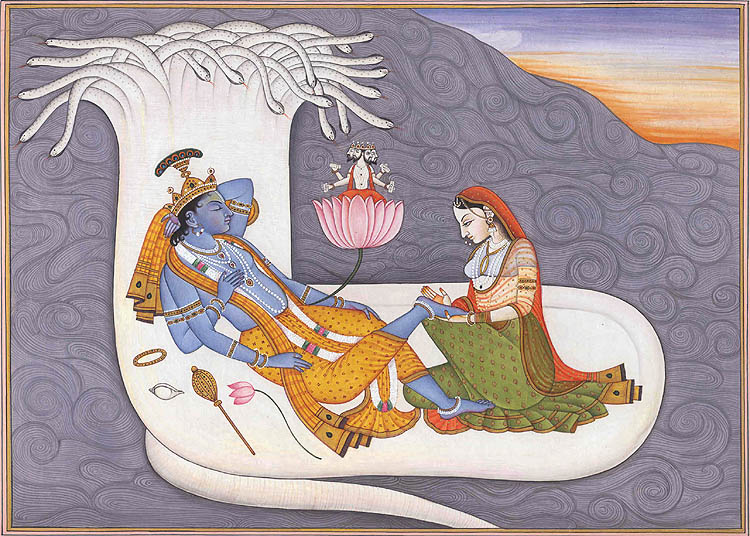
In traditional views, the definition takes different forms: from Śūnya — the cosmic void prior to manifestation — to Turīya, the state that pervades all consciousness, associated with samādhi. There is also the reading tied to the sleep of Viṣhṇu.
Roots and history
The roots of the word Nidrā already appear in the Upaniṣhads and the Mahābhārata, where the idea of "conscious sleep," "divine rest" and the experience of deep meditation is already present.
The development of Yoga Nidrā can be understood, in simple terms, across four phases:
- The Vedic-Upaniṣhadic and epic phase — the idea of conscious sleep and divine rest emerges.
- The tantric and medieval phase — the term becomes tied to meditative states, samādhi and inner practices such as nyāsa.
- The modern phase — Satyananda systematises the practice in the twentieth century.
- The contemporary phase — global spread, therapeutic use and scientific interest.
Tantra and the foundations of the practice
The foundations most relevant to contemporary practice rest on Tantra — from tan, "to weave," an unbroken thread — a doctrine of inner transformation carried out through the sacralisation of the body and practices of spiritual realisation. These practices use ritual, meditation, mantra and Nyāsa, ritual touch: directing consciousness, mantra and attention toward specific parts of the body. That logic of "moving attention through the body" sits very close to what would later become the consciousness rotation of modern Yoga Nidrā.
At that time, the methodological structure we know today did not yet exist — each tradition or lineage followed its own strategies. What existed were scattered elements: visualisation, mantra, interiorisation, attention to the subtle channels (nāḍī), and the cultivation of intermediate states of consciousness.
Twentieth-century systematisation
The most widespread form of Yoga Nidrā in the twentieth century — and the one most contemporary schools follow — comes from Swami Satyananda Saraswati, founder of the Bihar School of Yoga, one of the most influential contemporary yoga schools.
Satyananda didn't "invent" the practice: he systematised and simplified ancient techniques tied to Tantra, above all Nyāsa and Saṅkalpa. Working from the premise of preserving the thread of consciousness, this approach guides the practitioner into states between waking and (pre-)deep sleep, helping them become aware of their Saṃskāras — deep memories — and purify Karma.
From the 1960s onward, Satyananda developed a structured sequence combining relaxation, relaxation of consciousness, breath observation, awareness of sensory sensations, visualisation and Saṅkalpa. The aim of this simplification was to bring the practice to the ordinary practitioner, democratising what had previously been reserved for ascetics and yogis.
Satyananda studied the ancient traditions through his Guru, Swami Sivananda Saraswati, observed the liminal states of the mind, reorganised that material and gave it a modern pedagogical form — and that is how Yoga Nidrā became the practice taught today in many schools and therapeutic settings.
Structure of the practice
The classical form of Yoga Nidrā taught today usually includes preparation, resolve (saṅkalpa), rotation of consciousness through the body, awareness of breath, opposite sensations, visualisation and closing — a structure that appears both in historical accounts and in contemporary studies of the practice.
In practice, the body stays still, but the mind is guided with great precision. This organisation follows a clear pedagogical logic: first the body is stabilised, then attention, then the imaginal mind, and finally the subtle dimension of intention. The aim is a state of deep relaxation without loss of consciousness — different from simply falling asleep.
A second lineage: Swami Rama and the Himalayan tradition
Alongside Satyananda, Swami Rama — of the Himalayan tradition, founder of the Himalayan Institute — described, in Exercise Without Movement, a technique of rotating consciousness through 61 points of the body. The tradition calls it Śava-yātrā, "the journey of the corpse": consciousness of the physical body is released in order to enter the subtle body. It isn't Yoga Nidrā in Satyananda's strict sense, but it confirms that twentieth-century systematisation had more than one source — two lineages, drawing from the same tantric root, arrived at similar structures almost independently of each other.
An open debate
There is an important debate about the authorship and "antiquity" of the practice. Part of the traditional literature, especially within the Satyananda lineage, presents Yoga Nidrā as very ancient; other scholars, on the other hand, consider that the modern technique owes much to the development of psychology as a human science.
There are, then, two readings: one that follows an ancient conceptual layer — from the pre-Vedic phase through Tantra, through divine sleep and states of purification, up to meditative absorption; another that argues Yoga Nidrā, as practised today, is a fusion of ancestral techniques with twentieth-century psychology and psychoanalysis, structured methodically.
Yoga Nidrā today
Today, Yoga Nidrā is taught both in spiritual contexts and in secular, therapeutic settings. Recent clinical studies explore its relevance to relaxation, stress and states of consciousness, reinforcing its expansion beyond the traditional world of Yoga.
In recent decades, Yoga Nidrā has come to be applied in therapeutic contexts, with documented positive effects on stress, anxiety, insomnia, emotional regulation and other markers of physical and mental health.
This therapeutic expansion has helped turn Yoga Nidrā into an accessible method of care — it requires no physical effort and can be adapted to different ages and conditions. That's why it's practised today both in spiritual settings and in health and wellness environments.
Conclusion
Yoga Nidrā is a striking example of how a tradition can preserve its essence while adapting to new contexts.
Bibliography
Satyananda Saraswati, Swami. Yoga Nidra. Bihar School of Yoga / Yoga Publications Trust, Munger.
Eliade, Mircea. Yoga: Immortality and Freedom. Princeton University Press.
Rama, Swami. Exercise Without Movement. Himalayan Institute Press.
Yoga Nidrā — quick summary
| Context | |
|---|---|
| Meaning | "Sleep of Yoga" — deep sleep, but conscious. |
| Sleep of Viṣhṇu | Divine power, associated with Viṣṇu and the Devī. |
| Presence in the Vedas | No direct reference; the reading tied to Śūnya — the void, the cosmic Night, the origin of manifestation — is a later interpretation. |
| Central philosophical text | The Māṇḍūkya Upaniṣhad — waking, dream, deep sleep and turīya. |
| Purāṇa | Yoganidrā as a divine power associated with Viṣhṇu and the Devī — a later reading. |
| Medieval development | Related to interiorisation practices in later tantric and yogic texts. |
| Contemporary practice | Satyananda Saraswati (Bihar School) brings together relaxation, rotation of consciousness, breath, visualisation and Saṅkalpa. |
| Historical context | Probably a fusion of tantric and Vedic roots with modern psychology. |
Frequently asked questions
Is Yoga Nidrā the same as meditation?
Not exactly. Meditation, in many traditions, begins from waking consciousness. Yoga Nidrā starts from a guided state between waking and sleep — the body relaxes deeply while consciousness stays awake.
Does Yoga Nidrā replace normal sleep?
No. It is a practice of deep, conscious relaxation, not a substitute for physiological sleep — though many practitioners report a comparable sense of rest.
Do I need Yoga experience to practise Yoga Nidrā?
No. It is one of the most accessible Yoga practices — it requires no physical effort or flexibility, and can be done lying down.
Want to deepen your practice beyond the postures (āsana)?
At Āshram Gaya, Philosophy is the foundation of practice!
Book a drop-in class